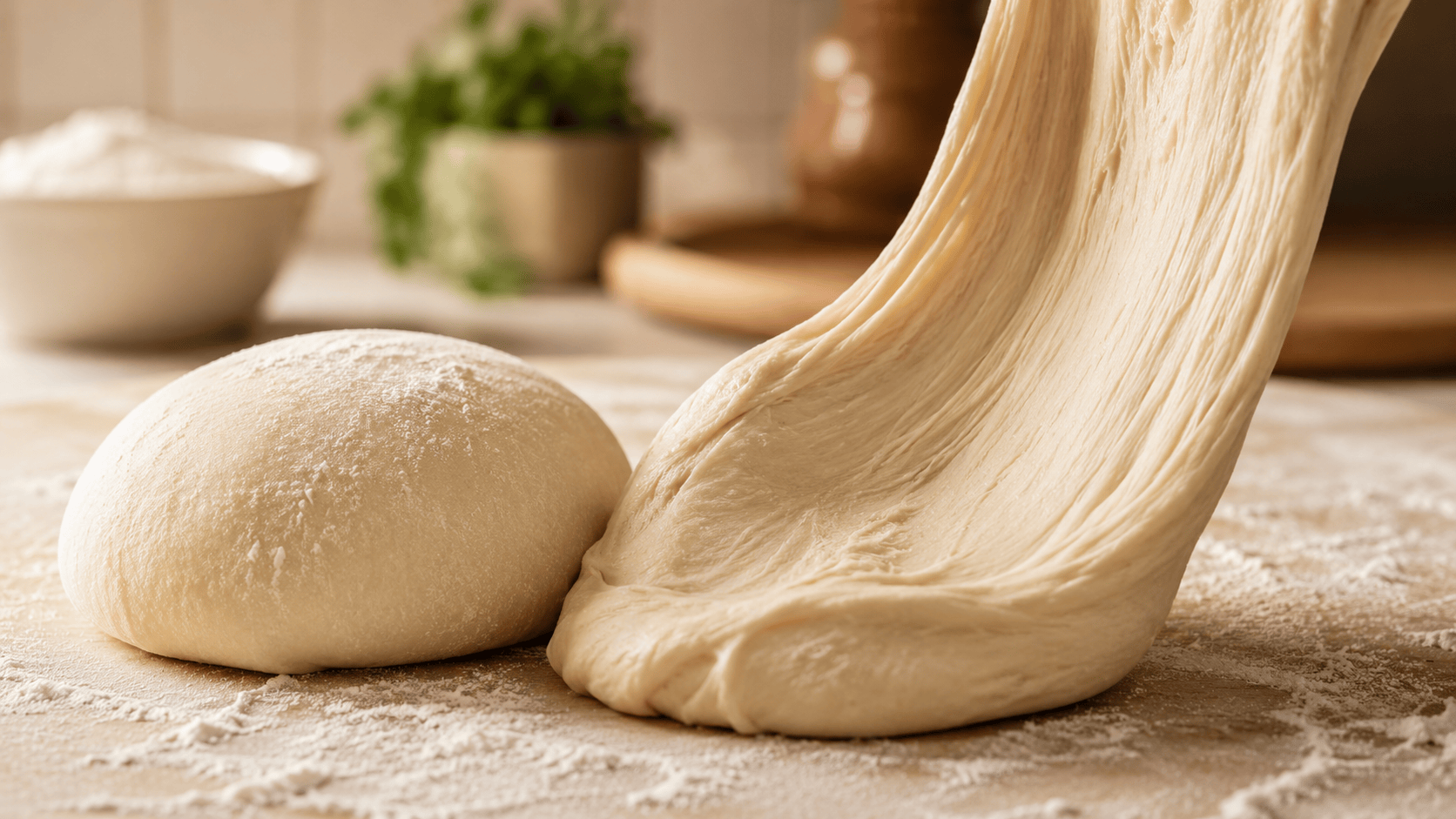
You flour the counter. You start stretching. And the dough fights back. It snaps into a tight ball, refusing to cooperate, tearing at the edges when you push harder.
You’ve been stretching for 10 minutes and your pizza is still the size of a personal pan.
You think: I didn’t knead it enough.
Actually, you probably kneaded it plenty. This is not a technique problem. It’s a patience problem.
What’s Actually Happening
Meet Gluten
When flour meets water and gets worked (mixed, kneaded, folded), two proteins called glutenin and gliadin link up to form gluten. Gluten is what gives dough its structure, its chew, its ability to stretch thin without tearing, and its ability to trap the gas that makes bread rise.
Freshly worked gluten is tight, elastic, and full of tension. The protein strands are coiled like springs. When you try to stretch them cold, they pull back. Hard.
Pushing harder just makes it push back harder.
Why Resting Works
Resting gives gluten time to relax on its own. The protein bonds loosen. The strands uncoil. The dough becomes extensible. It stretches without fighting.
At the same time, starch granules and flour particles continue absorbing water long after mixing stops. This is called hydration, and it makes the dough smoother, more even, and easier to handle.
Cold resting in the fridge adds a bonus: slow fermentation develops flavor. Yeast produces organic acids and alcohol over time, giving the dough a complexity that a same-day dough can’t match.
The Windowpane Test
Take a small piece of dough and stretch it between your fingers. If it stretches thin enough to see light through without tearing, the gluten is developed and relaxed. It’s ready.
If it tears immediately: needs more resting time.
How Long Should You Rest?
Resting time depends on what you’re making. Here are the practical ranges:
- Pizza dough: 1–2 hours at room temperature, or 24–72 hours cold in the fridge. The cold rest gives you better flavor.
- Bread dough: 1–2 hours for the first rise (bulk fermentation), then shape and rest again. Some breads benefit from an overnight cold proof.
- Pie crust: 30 minutes minimum in the fridge. This relaxes the gluten and keeps the butter cold. Both matter for a flaky crust.
- Pasta dough: 30 minutes wrapped at room temperature. Fresh pasta dough is stiff. Rest makes it rollable.
- Cookie dough: 30 minutes to 72 hours cold. Resting hydrates the flour fully and develops deeper flavor.
Always bring cold dough back to room temperature before stretching. Give it 30 to 60 minutes on the counter. Cold dough fights. Room-temperature dough cooperates.
One Myth Worth Busting
“Knead it longer if it keeps snapping back.”
More kneading tightens gluten further. If the dough is already smooth and well-kneaded and it’s still fighting you, the fix is rest, not more work. You can’t force gluten to relax. You have to wait it out.
Your Dough Resting Checklist
- ☐ Knead until smooth (5–10 minutes by hand, or until the dough passes the windowpane test)
- ☐ Cover and rest at room temperature: 1–2 hours minimum
- ☐ For pizza dough: cold rest in the fridge for 24–72 hours for best flavor
- ☐ Bring cold dough to room temp before stretching (30–60 minutes)
- ☐ Windowpane test: stretch a small piece. It should go thin without tearing.
Cook the Principle
Put this into practice.
Overnight Pizza Dough — 12 hr ferment · Beginner
Save this. You’ll want it next time you’re making dough.